Home Top Ad

Responsive Ads Here
Showing posts with label primary calendar. Show all posts

Since early 2016, a trend has evolved in how the 2020 presidential nomination process will operate. In that time, several formerly caucus st...

Since early 2016, a trend has evolved in how the 2020 presidential nomination process will operate. In that time, several formerly caucus states have abandoned the format in favor of a state-funded primary. That has happened in states like Idaho and Nebraska where there was already a primary option included in state law, but also in states like Colorado and Minnesota, where citizen-driven initiative or the legislature, respectively, created the primary option.

The latter group used to include the caucus-to-primary shift in Maine.

Used to.

The 2016 effort to re-establish a presidential primary in the Pine Tree state passed and became law, but most of the provisions in the bill (then law) expired on December 1, 2018. The sole surviving component -- the only part that did not expire -- was the study the Maine secretary of state was to have conducted with respect to the funding of the election. And while that report was issued on December 1, 2017, as called for in the statute, questions lingered about how state reimbursement to the counties conducting the elections would function among other issues.

The impetus for the sunset provision, then, was to allow for some fact finding on the funding issue, but also in order to force legislators to consider those implications before solidifying the primary for 2020. That consideration continues now.

However, there is legislation -- LD 245 -- newly before the Maine legislature to make permanent the provisions that re-established the presidential primary, but which expired toward the end of 2018. As FHQ described in 2016, those provisions include the following:

  • The secretary will then by November 1 of the year prior to a presidential election year set the date of the contest for some Tuesday in March. This date selection process will be done in consultation with the state parties. 
  • That last part is key. The state parties obviously have the final say in all of this. Despite there being presidential primary, the state parties are not required to opt into it. Those parties could continue to use caucuses as a means of both allocating and selecting delegates. But by providing some (early calendar) flexibility and by consulting with the parties, the new law maximizes the likelihood that the two state parties opt into the primary and allocate delegates through the vote in the contest. 
  • This legislation does a couple of interesting things. First, as mentioned above, the secretary of state has some carefully calibrated discretion on setting the date of the primary. The law does not set the primary for a specific date, but rather calls for it to happen on a Tuesday in March. More importantly, though, the decision on the date of the primary for 2020 and in the future rests with the secretary of state -- like in New Hampshire and Georgia -- instead of having to filter any date change through the legislative process. The discretion that the Maine secretary of state will have on this is far more restricted than in either New Hampshire or Georgia, but there is some flexibility there. That makes Maine a bit more adaptable than states with primaries scheduled for specific dates.

--
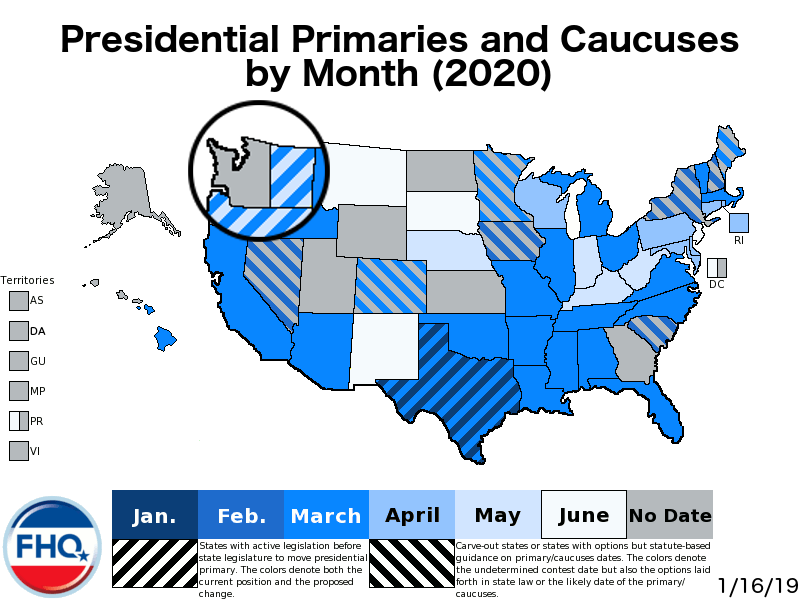
The Maine bill has been added to the FHQ 2020 presidential primary calendar.

Legislators are back at it in Washington state. Since eliminating the presidential primary for the 2012 cycle , there have been ongoing , al...

Legislators are back at it in Washington state.

Since eliminating the presidential primary for the 2012 cycle, there have been ongoing, albeit unsuccessful, attempts made to not only reposition the presidential contest on the primary calendar, but to reconfigure the process in the Evergreen state as well.

The sticking point in 2015, as illustrated in the descriptions linked to above as well as in 2017 when similar legislation was introduced, has always been how to balance both the lack of party registration in Washington and the history of a top two primary ballot in the context of a presidential primary.

None of the remedies to this point have been sufficient enough to get an omnibus presidential primary bill passed. And that has continued to keep the contest in its relatively late May position, but has also given Democrats continued opportunities to opt for caucuses in lieu of the presidential primary.

And now there are competing, partisan bills in the Washington state Senate to again make some attempt in 2019 at changing several aspects of presidential nomination process in the state. The Republican version -- SB 5229, and its House companion, HB 1262 -- would move the primary from the fourth Tuesday in May to the second Tuesday in March. This mirrors the date on which neighboring Idaho currently has its presidential primary scheduled and the date legislation in southern neighbor, Oregon, is targeting in a similar move.

In addition, the bill would also grant the secretary of state the ability to shift the date of the primary from that new March position to a date as early as February 15 or to move it to a later date. The added flexibility is intended to help the secretary to potentially facilitate a western regional primary with any state from among Alaska, Arizona, California, Hawaii, Idaho, Montana, Nevada, Oregon, or Utah.

The current law already gives the secretary the power to initiate a date change, but the ultimate decision to do so resides in a bipartisan group that includes the secretary as well as state legislative and state party leadership. Changes outlined in the new legislation would shift even more discretion to the secretary of state, but not without some guardrails. Should any new date chosen deviate from the second Tuesday in March date by more than three weeks, then the secretary would continue to have to receive a green light from bipartisan committee detailed above in order to move the primary.

All of that is relatively uncontroversial. Again, the point of contention has always been over who gets to participate in the presidential primary in a state with no party identification. Under the Republican proposal all registered voters would be able to participate, but it would be up to the state parties to decide which of those votes actually counts toward their delegate allocation.

Here's how that would work:
  • All candidates -- Democrats and Republicans -- would be listed on the ballot with their party affiliation listed as well. 
  • Partisans who wish to declare and affiliation with a particular party -- swear an oath through a mark on the ballot -- would only be able to vote for a candidate who shares that affiliation. Democrats can vote for Democrats in other words. 
  • Unaffiliated voters  -- whether they wish to declare that they are unaffiliated on the ballot or not -- would be able to vote for whomever they want, regardless of party, but may not ultimately have that vote counted toward the delegate allocation. 
  • Again, that decision rests with the state parties. 
Under the Republican plan none of the information stemming from the party declarations would be made public as it is in semi-open primary states with similar sorts of oaths.

In contrast, the Democratic bill, sponsored by nearly the entire Democratic leadership in the Washington state Senate and including the chair of the State Government, Tribal Relations and Election committee to which the bill has been referred, differs in subtle way. SB 5273 would also shift the date of the presidential primary from the fourth Tuesday in May to the second Tuesday in March. And the measure would also allow the secretary of state to alter the date in order to form a western regional primary (with the same group of nine states).

However, the secretary, unlike under the provisions in the Republican bill, would only be allowed to shift the date of the primary up as far as the national parties' delegate selection rules would allow (the first Tuesday in March under the current national party rules). That eliminates the potential for Washington to go rogue as is allowed under the Republican legislation.

Moreover, the secretary would have similar discretion to what secretaries of state have under the current law. Deviations from the second Tuesday could continue to occur, but not without a thumbs up from two-thirds of the bipartisan committee described above.

Again, these are subtle differences, but the secretary of state would have less latitude under the Democratic bill than the Republican one.

The framework also differs under the Democratic plan with respect to participation. The all-encompassing ballot would remain as would the partisan declarations. But the Democratic plan does not include the possibility of unaffiliated declarations; declarations that a voter is unaffiliated with a party. Yet, any voter who does not declare an affiliation could vote, but at the discretion of a state party, not have their votes counted toward the the delegate allocation. Finally, the Democratic legislation would make public partisan declarations of affiliation sworn to on the ballot.

There is a lot to digest in these bills, but the main takeaways are that both seek to change the date of the primary and both make some attempt at balancing the history in the state of a blanket primary-type ballot and the state parties' desire to tamp down on crossover voting in particular, but potentially curbing unaffiliated voters influencing the presidential nomination process.


--
The Washington bills have been added to the FHQ 2020 presidential primary calendar.

In what has almost become a custom in the Lone Star state over the last two state legislative sessions, a new bill has been introduced to mo...

In what has almost become a custom in the Lone Star state over the last two state legislative sessions, a new bill has been introduced to move the Texas primary from the first Tuesday in March to the fourth Tuesday in January.

Unlike the bill recently introduced further west in Oregon, this is not a new potential swipe at New Hampshire and the other carve-out states. In fact, Lyle Larson (R-122nd, San Antonio) has made this a habit since 2015. But this is merely the representative's third try at a "why not Texas?" bill; one he called a "flamethrower" intended to send a message in 2017. And the current legislation -- HB 725 -- is likely to continue to get the same sort of reaction. Other members on the committee will like the idea of Texas stealing the spotlight, but elections administrators from the county level will balk as will the two major parties in Texas. The latter continues to take issue with the move because of the implications -- national party penalties -- it would have for the delegations the state would send to the national conventions in 2020.

The 2015 version failed to get out of committee, but the 2017 version cleared that committee hurdle only to die from inactivity when the session adjourned. The 2019 version is likely to meet a similar fate.

Historically, Texas just has not budged much from its primary positions. Legislators have only willingly moved the primary twice in the post-reform era; once from May to March for 1988 and again from March to earlier March for 2008. Redistricting dispute forced the state to shift to a late May primary for the 2012 cycle.

More on the history of attempted Texas primary movement here.

--
The Texas bill has been added to the FHQ 2020 presidential primary calendar.

Thoughts on the invisible primary and links to the movements during the day that was... As presidential nomination cycles have come and gone...

Thoughts on the invisible primary and links to the movements during the day that was...

As presidential nomination cycles have come and gone over the years, the stories change in terms of how states maneuver within that system and why. That is not to suggest that the collision of states and the decision-making conditions they confront is complete chaos every four years. Rather, the terrain is constantly shifting. That is true for a lot of electoral decisions that state legislatures make, and that includes how states position their delegate selection events -- primaries and caucuses -- on the quadrennial presidential primary calendar.

Eight years ago, nearly half the states in the country had newly non-compliant primary dates leftover from a 2008 cycle that saw a slew of states push into February and cluster primarily at the beginning of the month. When the national parties informally coordinated a later start to primary season for 2012, all those February states from 2008 had to make changes to state law.

And the result was at least somewhat predictable. State governments that were under unified Republican control shifted back their dates much less than did the handful of states that were controlled by Democrats after the 2010 midterm elections. Whereas Democratic-controlled states pushed back to traditional positions (California and New Jersey back to June) or positions later on the calendar (the northeastern/mid-Atlantic regional primary in late April), most Republican-controlled states ended up somewhere in March.

At least part of the motivation, then, was partisan. Decision makers in Republican state governments were preparing for an active nomination race and attempted to schedule their primaries for advantageous -- for voters and for drawing candidate attention -- spots on the calendar. Democratic decision makers had no such similar calculus. With no real competition for the Democratic nomination, decision makers in Democratic-controlled states could afford to shift back further in 2012 to take advantage of a new series of delegate bonuses the DNC built into their delegate selection rules for that cycle.

However, when the calendar flipped over four more times, the decision-making matrix at the state level was different for 2016. Both parties had varying levels of competitive races looming and again, acted in at least somewhat predictable ways. Republican-controlled states, already largely in early positions, saw minimal movement.

But Democratic side of the ledger was different. First even in 2014, before the 2015-16 legislatures had been elected, Democrats had a clear frontrunner for 2016 in Hillary Clinton. Second, after the 2014 midterms, there were only a handful of states with unified Democratic control. That is a recipe for little movement, and, in fact, none of those seven Democratic states made any changes for the 2016 cycle.

So as the process heads into 2019, what does the balance of power look like in states across the country for 2020?

For starters, the number of Republican-controlled states is similar to 2015. While there were 23 states with unified Republican control in 2015, there are 22 in 2019. However, there are more Democratic-controlled states now than four years ago and the gains came not from Republican states, but from those with control divided in some way, whether inter-branch or intra-branch.

Not only has the map of partisan control changed, but so too have the conditions under which these decisions are made. Like 2011 or 2015 for Republicans, Democratic decision makers in 2019 seemingly have a wide open and competitive nomination race on the horizon. Those actors, like Republicans in the recent past, have incentives to potentially shift around the dates on which their presidential primaries are held.

That incentive was great enough that California moved from June to March for 2020 back in 2017, an atypical time in the cycle to make such a move.

And that incentive could be enough to motivate the cluster of Democratic-controlled states in the northeast to coordinate an earlier cluster of contests; the inverse of 2011. There is already some evidence that a western regional primary could form in a position just a week after Super Tuesday.

On the Republican side the motivation is different, and not exactly like what Democrats faced in 2011. Yes, defending the president is chief among the concerns of Republicans like the Democrats of eight years ago. However, the defense is potentially different. Democrats, with no real threat of a challenge to President Obama, made moves potentially with the general election in mind; to attempt to influence who emerged as Obama's opponent.

Republican legislators may act, but with the nomination phase in mind; to ward off a challenge to the president. This may happen, as was the case eight years ago on the Democratic side, at the behest of national Republican actors, but it will take place at the state level.

Does that mean Republican-controlled states unilaterally pull back and set later dates? That would be an historical anomaly. States have not typically done that except in situations where it has meant consolidating separated primaries in order to reduce costs; save a line on the state budget. But in more polarized times, both nationally and increasingly in state legislatures, the rules may be different.

It is early in the 2019 state legislative sessions, but it is there that these calendar decisions will be made, and begin to provide a picture of what the 2020 presidential primary calendar will eventually look like.


--
Elsewhere in the invisible primary...

1. Gillibrand end last week with a flurry of activity, whether it was lining up potential campaign headquarters, planning trips to Iowa, staffing up, or privately signaling her intentions.

2. She's not the only one headed to Iowa. Brown is going to visit the Hawkeye state too.

3. Swalwell is taking a late January trip to New Hampshire.

4. Inslee is taking flak back home from Republicans and from some New Hampshire Democrats.

5. In West Virginia, announced Democratic presidential candidate, Richard Ojeda, is resigning his state Senate seat to run for president.

6. Meanwhile, Hawaii congresswoman Tulsi Gabbard is in.

7. So is Julian Castro.

8. And DeBlasio isn't closing any 2020 doors, but, boy, is the clock ticking and the alarm may have already sounded for statements about door-closing/considerations being either serious or taken seriously.

9. Warren continues to add staff. This time some New Hampshire staff additions were announced while Warren was visiting the Granite state.

10. If Biden's walking, he's running [for 2020].


Has FHQ missed something you feel should be included? Drop us a line or a comment and we'll make room for it.

In what may, in part, be the opening salvo in the 2019 legislation affecting the 2020 presidential primary calendar , Oregon has a couple of...

In what may, in part, be the opening salvo in the 2019 legislation affecting the 2020 presidential primary calendar, Oregon has a couple of interesting bills prefiled and ready for when the legislature in the Beaver state convenes later this month.

Both bills seek to move the Oregon primary from the third Tuesday in May up to the second Tuesday in March not just in presidential election years but in all even-numbered years. This differs from when Oregon shifted in the past (for 1996) or when attempts were made in the recent past to move the primary (2007 and 2015). In those instances, the presidential primary was split from the May primary for other offices and moved (or proposed to be moved) to March or earlier dates. In 2019, the legislation proposes moving everything up to March, thus saving the expense of funding a new and stand-alone presidential primary.

However, both 2019 bills offer a twist on this scheduling.

HB 2107 calls for a move the second Tuesday in March, but also is a bit more provocative in giving the Oregon secretary of state the discretion to change the would-be standardized March date "if the date change will result in the primary election being held seven or more days after the date on which the first primary election held during that election cycle is held in any other state."

In other words, this is a bill that could threaten New Hampshire if it becomes law.

If the first primary -- New Hampshire's -- is seven or more days before the second Tuesday in March -- it always is -- then the Oregon secretary of state would have the discretion to move the primary and time before December 1 of the year prior to a presidential election. Ostensibly, the intention is for the secretary of state to have the discretion to move forward on the calendar, but he or she would also have the ability to move the primary back. That is not something -- at least in the introduced version of this legislation that is prohibited.

The second bill -- HB 2279 -- is similar but less provocative. At the request of the secretary of state, this legislation was introduced and would not only move the primary from May to the second Tuesday in March, but it would allow the secretary of state to join a regional primary if two or more states from among Arizona, California, Idaho, Nevada, Utah, or Washington wind up clustered on a date other than the second Tuesday in March. Nevada will be among the carve-out states in February and California already has a primary scheduled for the first Tuesday in March. But Idaho is is currently stationed on the second Tuesday in March and Washington has eyed that position in the past. Utah also has a primary option, but a date has not been settled on yet.

It look as though the second Tuesday in March could end up as post-California/Super Tuesday western states/PAC 12 regional primary spot.

But first the Oregon legislature has to act on this legislation and other pieces elsewhere have to fall into place. The Oregon part of the equation will become clearer when the legislature convenes on January 22.


The Oregon legislation will be added to the evolving FHQ 2020 Presidential Primary Calendar.

Thoughts on the invisible primary and links to the movements during the day that was... The National Conference of State Legislatures has  t...

Thoughts on the invisible primary and links to the movements during the day that was...

The National Conference of State Legislatures has this calendar as well, but in alphabetical order. FHQ is more concerned with sequence. Which state legislatures convene first, when do their sessions end and how does this impact the scheduling of presidential primaries? [More below the calendar.]

2019 State Legislative Session Calendar (sequential)
Date (Convene)StatesDate (Adjourn)
January 1, 2019Pennsylvania
Rhode Island
year-round2
mid July
January 2Maine
Massachusetts
New Hampshire
Washington, DC
June 19
year-round2
late June
year-round2
January 3Indiana
North Dakota1
April 29
April 26
January 4ColoradoMay 3
January 7California
Idaho
Montana
Ohio
Wisconsin
September 13
early April
May 1
year-round2
year-round2
January 8Delaware
Kentucky
Minnesota
Mississippi
South Carolina
South Dakota
Tennessee
Texas
Wyoming1
June 30
March 29
May 20
April 7
May 9
March 29
late April
May 27
early March
January 9Connecticut
Illinois
Maryland
Michigan
Missouri
Nebraska
New Jersey
New York
North Carolina
Vermont
Virginia
West Virginia
June 3
year round2
April 8
year-round2
May 17
June 6
year round2
year round2
mid July
mid May
March 10
March 9
January 14Arizona
Arkansas
Georgia
Iowa1
Kansas1
Puerto Rico
Virgin Islands1
Washington
late April
March 14
early April
May 3
mid May
November 30
year round2
April 28
January 15Alaska1
New Mexico
April 14
March 16
January 16Hawaii1May 2
January 22OregonJune 30
January 28UtahMarch 14
February 4Nevada1
Oklahoma
June 3
May 31
March 5Alabama
Florida
June 18
May 3
April 8LouisianaJune 6
Notes:
1 States in italics are caucus states. State parties and not state legislatures control the scheduling of those contests.
2 State legislatures whose session calendars have them meeting throughout the year.


2019 in the state legislatures
The table answers the first two of the three questions posed above. With the schedule of state legislative sessions down, though, what impact will that have on the formation of the 2020 presidential primary calendar? The biggest thing is that 2020 is not 2016, but it is likely to share more similarities with 2016 than 2016 did with its immediately prior cycle, 2012. There are not nearly 20 states that have to make some form of scheduling change to comply with changes to the structure of the primary process at the national party level. In 2008 both parties allowed February contests. For 2012, both parties changed their minds and together informally constructed a calendar structure that had the carve-outs in February and all other states in March or later.

Right off the bat, then, the 2012 cycle had a tension between where state laws had various primaries scheduled (February or before) and what the national parties wanted in terms of the overall calendar for most states (March and later). That tension has already been greatly minimized. 2011 saw a significant amount of backward primary movement, and that process continued in 2013-14. Importantly for 2016, past rogue states like Florida, Michigan and Arizona moved back from the brink. That does not mean that there will not be other rogues out there, but 2016 demonstrated that the parties had -- at least for that cycle -- a workable mix of penalties and bonuses to keep states in line.

Will that hold in 2020? The early indications are yes, but 2019 will settle that score.

Here are a few things to look out for as state legislative session progress (mostly) over the first half of  2019 and into the latter half of the year.

Primary movement or primary movement?
A couple of states -- California and North Carolina -- made early moves on the 2020 calendar. Both shifted their contest dates to Super Tuesday in 2017 and 2018. That is atypical as most states tend to wait until the new legislatures convene in the year before the presidential election to settle on the timing of their presidential primaries. And while one can expect there to be additional movement up and down the calendar in the coming months, that is not the only type of movement witnessed either thus far or likely witnessed in the near future.

Yes, some states have changed primary dates, but others -- former caucus states -- have moved to primaries as the means allocating delegates for the 2020 cycle. This trend began in 2016 (Maine and Minnesota), continued in 2017 (Colorado and Utah), stretched into 2018 (Idaho and Nebraska), and could push into 2019 in states like Hawaii and Washington. The former saw legislation die during the 2018 session and the latter has a state-funded primary option, but the Democratic party in Washington has eschewed it in the post-reform era. Washington Democrats are set to finalize their plans by March/April.

But does the trend push beyond just that group? 2019 will answer those questions and in the state legislatures.


Likely Movers
The impetus to move for 2020 is different than it has been in the recent past. Republicans are idle at this time, so the motivation is less to move around because of an active nomination race and more to do so in order to potentially protect the renomination odds of the current president. There have been some discussion about South Carolina canceling its primary in favor of a caucus system for instance. But are there states more likely to move than others?

When one thinks about that, there are a few factors for which to account. FHQ will not be exhaustive here, but only point toward the most likely factors motivating primary movement. One is where the contests are currently scheduled. The movement seen so far for the 2020 cycle has been later states moving up, California most clearly.

But second, look to the partisan alignment of state legislatures. That has not been a significant factor in past iterations of my research, but in an increasingly polarized environment, may be becoming a more significant one. Democratic-controlled states, then, might be more inclined to seek out earlier dates. Look, in particular, at the group of mid-Atlantic/northeastern states with late April primary dates as of now. Each has moved pretty far back on the calendar over the last two cycles. Most also have some Democratic control. A wide open Democratic race may draw them to earlier dates for 2020.

Contrast that with the Republican-controlled state governments across the country. Their motivation is different. Protect the president? Then move back (and see the state party shift to a winner-take-all allocation method). Hurt the Democrats? Then move back and shift an important constituency concentrated in a particular region. Think about that SEC primary coalition from 2016. That could break up and push the votes of a valuable Democratic voting bloc -- African American -- to later in the calendar. That might affect some candidates more than others.


Regional primaries
Part of what drove some of those mid-Atlantic/northeastern states back in 2012 and 2016 was the allure of a regional primary clustering bonus from the Democratic National Committee. Neighboring states that hold their primaries together and late enough on the calendar are rewarded with additional delegates; more activists they can take to the convention. That is no small thing for a small state. While it potentially means a lesser voice in the primary process, it means a greater voice at the convention.

That bonus may hold less sway this time around with an active nomination race than it has in the two most recent cycles. Instead one may see attempts to replicate the SEC primary from 2016. There are elements of a Great Lakes primary already on March 10. California's move may prompt the formation of a PAC 12 primary (if California does not already represent that on its own). But there is reason to believe those clusters, if they occur, will fall earlier in the 2020 than in 2016 or 2012.

Anyway, as state legislatures begin to convene, they will be considering any number of things. Undoubtedly though, that will include primary calendar movement if not caucus to primary movement.


--
Elsewhere in the invisible primary...

1. One western state governor is headed to the first in the west caucus state. One seemingly likely 2020 candidate -- Governor Jay Inslee (D-WA) -- is trekking to Nevada.

2. On the Sanders front, former campaign manager, Jeff Weaver, will work in a different capacity in any presidential campaign the Vermont senator launches for 2020.

3. Speaking of Sanders, New Hampshire groups supportive of his candidacy will hold events this weekend across the Granite state.

4. New Hampshire will also welcome Elizabeth Warren this weekend.

5. Steyer opts to focus on impeaching Trump rather than seek the 2020 Democratic presidential nomination. Yes folks, #WinnowingWorks.

6. O'Rourke is more inclined to run than not at this point.

7. While Booker and Sanders are in South Carolina for MLK day, Harris will be back in Oakland to make her 2020 intentions, if not official, then clearer. ...and they have already been pretty clear if one has followed the signals.

8. Finally, ask and ye shall receive. The burning question on everyone's mind in early 2019: Will Jeb Bush run in 2020? Nope.


Has FHQ missed something you feel should be included? Drop us a line or a comment and we'll make room for it.

As we head into 2019 and the heart of the invisible primary, FHQ is beginning a series to catalog some of the maneuvering going on among and...

As we head into 2019 and the heart of the invisible primary, FHQ is beginning a series to catalog some of the maneuvering going on among and between the various campaigns and candidates as they move from the nascent to the real. We have been doing this for some time on Twitter, but in an effort to protect against some of the activities disappearing into the ether, we'll archive them here. 

Has FHQ missed something you feel should be included? Drop us a line or a comment and we'll make room for it.

--
While the Republican National Committee had an opportunity in 2017 and stretching into the first three-quarters of 2018 to make changes to aspects of the presidential nomination process for 2020, the party largely left well enough alone. And that is in keeping with how parties have approached process questions when they occupy the White House. Candidates who have won not only nominations, but the presidency tend to like the process that got them there. As such, the parties under their direction more often than not will either make no changes at all or only minor changes.

Look at the DNC in the 2009-2010 period. There was a commission -- the Democratic Change Commission -- that examined the way in which the party nominated its presidential candidates, but once the recommendations had worked their way through the Rules and Bylaws Committee, the result was a just a handful of small changes. The clustering bonus, where neighboring states could schedule their contests together after a certain point on the calendar in order to net a 15 percent increase in their delegation, stands out. But the most consequential, although often overshadowed change, was the increase in the total number of base delegates from 3000 to 3700 in the convention call. That had the effect of diluting the impact of superdelegates, or would have if the 2012 Democratic nomination had been competitive. In reality, it rewarded more Democrats with a trip to the national convention.

But those are the sorts of changes that often come out of White House-occupying parties.

And the 2017-2018 Republicans were no different. They had an opportunity through the Temporary Committee on the Presidential Nominating Process to examine the rules for 2020 and make any recommendations for changes. And they did. But the only change that emerged was the elimination of a 2016 creation: the debates sanctioning committee.

Everything else was left untouched. And that included the Rule 40 threshold determining whose name can be placed in nomination at the national convention. That was left alone because only the convention can change it.

And though the low bar of that threshold remains as it was set in 2016 at the convention, it has been a topic of some discussion in recent weeks. But the efforts to to change it -- to raise it -- are both too late and have been shot down by the Trump reaction effort.

The campaign will endeavor instead to protect itself by "dominating the delegate game," by focusing not on changes to the national rules governing delegate selection, but on state-level rules for selecting and allocating delegates (created in response to the national guidelines).

In that patchwork of state party rules opportunities exist for presidential candidates. Creating the most advantageous calendar, for example. Or altering the balance of winner-take-all or proportional states for another.

Actually, this is at least part of where we are likely to see some changes during 2019. State parties will finalize their delegate selection processes in both parties as 2019 wears on. And although it is a gamble -- because what appears advantageous now may not be in 2020 -- we may see an effort on the Republican side similar to what was witnessed on the Democratic side in 2011: a national party urging action on the part of the states.

If a state is viewed now as a strong Trump state in the nomination phase of the process, then why not move it to a point on the calendar where the number of Trump delegates could be maximized? Take Georgia. Traditionally the Peach state has been a Super Tuesday mainstay. And it may still be in 2020. However, the newly elected Republican secretary of state there may hear from the Trump campaign. So might the Georgia Republican Party. The former could set the date of the Georgia primary for some point after March 15 and that would allow the latter to set the allocation method for winner-take-all (without penalty).

The same could be said for other early primary states where there is some combination of Republicans control of state government and perception of Trump doing well there in 2020. If one wanted to massage the delegate game a bit in order to raise the number of Trump delegates at the national convention, then this would be the way to do it.

And bear in mind, any changes to the primary calendar that Republicans make affects the Democratic process too. While the Democrats of 2011 sought to potentially influence the 2012 Republican process, this 2019 Republican maneuvering adds an additional element: protecting the president.


--
Elsewhere over the weekend...

1. Elizabeth Warren had a pretty good roll out to her presidential campaign from exploratory committee announcement to the trickle of stories about staffing hires to her initial Iowa trek. She was in the news or steadily made it all week.

2. Castro has surround his January 12 announcement event with trips to all the early states but South Carolina.

3. Cory Booker won't be the first and won't be the last to visit the Palmetto state, but he'll speak there on MLK.

4. The Booker super PAC continues to take shape.

4. Biden continues to hold support at home.

5. And no one has passed his test to keep him out of the 2020 sweepstakes yet either.

6. California donors are willing to let the dust settle a bit on the Democratic nomination contest.

7. One can't do one of these without an O'Rourke mention. Draft Beto has moved into South Carolina.

8. According to his wife, Sherrod Brown is heading for an announcement "within the next two months".

Nebraska Democrats voted on December 8 during their quarterly State Central Committee meeting to conduct the state party's 2020 national...

Nebraska Democrats voted on December 8 during their quarterly State Central Committee meeting to conduct the state party's 2020 national delegate allocation process through a presidential primary.

This is a reversion to the mode of delegate selection Cornhusker state Democrats used prior to 2008. For that cycle and the succeeding two cycles, the party held caucuses. And the primary motivation for the switch from primary to caucus ahead of 2008 was to move to an earlier date on the presidential primary calendar. That allowed for (Saturday after Super Tuesday) February caucuses as opposed to the traditional May primary.

But that move never got rid of the primary. By Nebraska law, caucus or not, a party's candidates appear on the presidential primary ballot. And in both of the competitive Democratic presidential cycles of 2008 and 2016 the later primary added two turnout data points for comparison to the caucuses. Despite the later date of the non-binding primary contests, the turnout was higher than in the caucuses.

That has remained a sticking point in discussions in and out of the state party in Nebraska and has been a primary incentive to move back to a primary election currently scheduled for May.

Nebraska now becomes the sixth state to make a switch from a 2016 caucus to a 2020 presidential primary; joining Colorado, Idaho, Maine, Minnesota, and Utah.

The Nebraska change has been added to the FHQ 2020 presidential primary calendar.

--
Related Posts: 
Caucus or Primary? Nebraska Democrats Have the Decision Before Them

Nebraska Democratic Party Platform Committee Passes Caucus-to-Primary Resolution

Nebraska Democrats Signal Caucus-to-Primary Switch for 2020

Nebraska Democrats will convene this weekend to conduct their quarterly State Central Committee meeting. And on the agenda is the caucus or...

Nebraska Democrats will convene this weekend to conduct their quarterly State Central Committee meeting. And on the agenda is the caucus or primary question as the group continues to consider the state party's draft delegate selection plan for 2020.

Yet, the party is not newly coming into this discussion. In fact, at its 2018 state convention this past June, Democratic delegates considered the matter as well. The state convention platform committee at the time ultimately passed a resolution calling for a switch to a primary from the caucus system the party has used to select and allocate national convention delegates from the Cornhusker state for each of the last three cycles (since 2008).

But news of the inner workings within the party on the caucus-to-primary question went quiet after that point. The convention resolution on the matter did not (and does not now) appear among the listed resolutions that were passed on the floor of the convention at the time.

However, it was listed among the passed resolutions in late June. Here's the language:
Why it disappeared from the passed resolutions was a mystery; one that was not settled later when I tried to reach out to the Nebraska Democratic Party (NDP) about it in July once I returned from vacation. Nor were they answered to any greater degree by the resolution's sponsor, Angela Thomas when FHQ reached out to her once news of the December State Central Committee meeting was reported toward the end of November.

Ultimately, this really is neither here nor there, but it was odd.

Regardless, the resolution would have been non-binding on the party. Additionally, the progression of the idea -- switching from a caucus to a primary -- has followed if not taken an expedited path as laid out by NDP Chair Jane Kleeb at the time of the state convention:
The party’s State Central Committee most likely won’t make a final decision until March, after the national Democratic Party issues guidance to the states, said Chairwoman Jane Kleeb.
The party has seemingly moved the consideration of caucus-to-primary up a quarter from March 2019 to December 2018 in order to incorporate the decision on mode of delegate selection into the party's draft delegate selection plan to be submitted to the DNC Rules and Bylaws Committee by early May.

Heading into the decisive State Central Committee meeting December 7-8, it should be noted that the resolution to eliminate the caucuses drew cheers back at the state convention when it was introduced in the platform committee and as of late November the idea of a caucus-to-primary shift was said by party Chair Kleeb to have held a three to one advantage among the party's grassroots.

Take that as internal momentum to change the state Democrats' mode of delegate selection for 2020. And that parallels the external momentum to move from caucuses to primaries in Colorado, Idaho, Maine, Minnesota, and Utah that has already produced change in 2016-18.

In the end, the price tag associated with creating an all-new and separate presidential primary election was too much for Wisconsin legislat...

In the end, the price tag associated with creating an all-new and separate presidential primary election was too much for Wisconsin legislators. The Joint Finance Committee balked:
The plan to move the presidential primary was aimed at making sure conservative state Supreme Court Justice Daniel Kelly is not up for election on the same day as the presidential primary in April 2020, when Republicans fear Democratic turnout will be high. 
Moving the primary to March would cost taxpayers nearly $7 million and municipal clerks warned it would be hard to conduct so many elections so close together. 
The committee didn't approve the legislation and leaders said they doubted it would come up on the floor of the Senate or Assembly.
SB 885 did not come up on the floor, and will end up a casualty of this brief legislative lame duck session. The idea of a March presidential primary likely ends there. First, Republicans in the legislature pushing the measure would face resistance from the same elections clerks in January but would also have to contend with a Democratic governor then. And even if they sought to move everything -- presidential primary and judicial election -- up to March, such a proposal would save on expenditures, but also likely continue to draw the ire of elections officials because of the quick turnaround from the February spring primary.

Obviously, any proposal to save the expenditure and move everything to March would additionally fail to lower the turnout on the judicial election. It would still be tethered to the presidential primary.

As described in an earlier post, this discussion of a primary move happened under unique circumstances in the Badger state, unique enough that it likely will not be repeated as the legislature convenes a new session in January. Often proposed primary shifts will come up on a recurring basis in state legislatures, but this one in Wisconsin is unlikely to follow that trend.

And all is not lost: that first Tuesday in April date would have Wisconsin -- as of now anyway -- all by itself in 2020.

Legislation has been introduced during the lame duck session of the Wisconsin legislature to create a separate presidential preference prima...

Legislation has been introduced during the lame duck session of the Wisconsin legislature to create a separate presidential preference primary election. SB 885 would not only split the presidential primary off from the spring election -- typically tethered to judicial elections -- but would schedule the presidential contest for the second Tuesday in March.

Given the 2020 calendar layout, that would mean a shift up by four weeks for the Wisconsin primary, pushing it up in line with previously scheduled contests in Michigan and Ohio. Conceivably, the new Minnesota presidential primary could end up on that date as well. Parties there can decide on a date other than the first Tuesday in March. With Minnesota and Wisconsin on board, the second Tuesday in March would look like a Great Lakes/Big Ten primary on the heels of Super Tuesday.

--
UPDATE (12/4/18):
The potential primary move continues to draw the ire of elections administrators on both sides of the aisle in Wisconsin:
The bipartisan panel [the Wisconsin Election Commission] voted 6-0 on a motion to inform lawmakers of the difficulties of moving the election, which could cost as much as $6.8 million and which a top Republican leader has said is aimed at helping re-elect conservative state Supreme Court Justice Daniel Kelly.
FHQ talked about some of that opposition here:
Find much more about the contours of the potential Wisconsin move here.


This legislation will also be added to the 2020 presidential primary calendar here.

In the wake of the 2018 midterm elections, Republicans in Wisconsin are looking at a change to the scheduling of the 2020 presidential prima...

In the wake of the 2018 midterm elections, Republicans in Wisconsin are looking at a change to the scheduling of the 2020 presidential primary in the Badger state.

And in the scope of all post-reform shifts in the dates of presidential primary elections across the country, it is not a typical proposed move. To be more precise, the proposed move forward -- from an April position on the calendar to March -- is entirely within the norm. State actors began to consider pushing up primary dates for 1972 almost before the ink was dry on the McGovern-Fraser reforms and they were adopted. That is not what is atypical about the potential move in Wisconsin. 

Instead, it is the how, the why, and the when of the proposed shift in Wisconsin that deviates from how most states have gone about these changes in the past. 

First, the timing of this is unusual. Although it is not unheard of, it has historically been the case that most of the movement on the presidential primary calendar has taken place in the year before the presidential election. There are exceptions of course. Missouri legislators pushing the 2004 presidential primary in the Show-Me state up from March to February in 2002 comes to mind. But while there are exceptions, the year prior to a presidential has been the window in which states have tended to make these scheduling decisions. 

The reasoning is sound enough: That is when state actors the most up-to-date information (who is running, which parties have contested races, what other states are doing, etc.). It is also a time that occurs at the confluence of new legislatures being sworn in following midterms and when the urgency for a change of primary dates is at its highest (or at least when the timing is most on the radars of state legislators).

But by that mark, Wisconsin legislators are only slightly jumping the gun, right? After all, Texas legislators in 2010 prefiled legislation to move the primary in Lone Star state up for the 2012 cycle. However, Texas legislators introduced that legislation in anticipation of the start to the 2011-12 session. That is not what is happening in Wisconsin. Rather, legislators in the Badger state are considering these changes as part of a lame duck session as the bookend to unified Republican control of state government. 

That draws this back to the how and why of the proposal. 

Again, it is not atypical for states to move up the dates of their presidential primaries in post-reform era. In fact, Wisconsin has done this in the past: moving the spring election, including the presidential primary and the general election for judicial and other offices, from April to March for the 1996 cycle.1 And then for the 2004 cycle, legislators there bumped the presidential primary from the spring election in April to the spring primary in February. 


But in both of those cases the Wisconsin presidential primary move was either tethered to the move of a set of elections -- the whole spring election was moved -- or toggled from one pre-existing election (the April spring election) to another (the February spring primary). The distinction is subtle, perhaps, but meaningful. Those moves meant the budgetary requirements were close to neutral. 

Neither added to the budgetary bottom line in Wisconsin. 

Contrast that with the proposed shift for the 2020 cycle. The idea of the hypothetical bill -- and none has been introduced to this point -- would be to create an all-new and separate presidential primary to be scheduled in March 2020, between the February spring primary and the April spring election. That new election would cost the state at least $7 million (and mean a third election in consecutive months for election administrators).

But why not shift into that February position as legislators in Wisconsin did during the 2004 cycle? That is not a viable option to legislators in 2020. Whereas February contests (outside of Iowa and New Hampshire) were allowed by national party rules during 2004, they are not in 2020. Nor were they in either 2012 or 2016 when states faced penalties to their national convention delegations for timing violations. This is why the 2015 bill to once again move the Wisconsin primary from April to February went nowhere. It would have put the Wisconsin delegations to both parties' national conventions at risk of penalty.

Left with no realistic alternative among the elections already on the calendar (the costs of which are already accounted for), Wisconsin Republicans are focusing on separate March option. That option, if not the price tag, are additionally enticing to a party set to lose unified control of state government when Democrat Tony Evers is sworn in as governor because it would hypothetically separate a high-profile, high turnout presidential primary from the spring election for judicial offices. 

That would put the spring election at the close of a February-March-April election-a-thon (elect-a-thon?) in Wisconsin. That is not only difficult for election administrators and places a significant burden on voters as well. Turning out for three elections in three months runs the risk of driving up voter fatigue and driving down turnout. The latter is seen as potentially advantageous to Republicans in the state and those behind this proposed primary move being floated. 

And that makes the why of this unusual too. It counters the exact kind of maneuvering that FHQ mentioned just recently: that idle Republican legislators facing an at-this-point noncompetitive presidential renomination race would consider moving primaries back rather than forward. That, however, is more nationally-focused maneuvering. The proposed Wisconsin move is more locall-minded. Procedurally, it is aimed not at the national implications in either the Democratic or Republican presidential nomination races, but at a methodical severing of one high-profile election (presidential primary) from another election (the judicial election set to occur during the April spring election).

To the extent the scheduling of presidential primaries is localized like that, it almost always focuses on the costs (see the 2012 cycle in particular). It is rarer to see something as politically raw in its calculations as the proposal in Wisconsin. Although one could look on it as a logical, albeit localized, extension of a slippery slope one could trace to national Democratic maneuvering in the lead up to 2012.

Look, this is not one of those "on both sides" sorts of things, but as the 2020 cycle heads into 2019, these are the sorts of process tales that need to be told beyond the regular rhythms of primary movement in the post-reform era. 

--
1 That move for 1996 was part of an effort to create a Great Lakes regional primary that included Illinois, Michigan, and Ohio.

In the time since the midterms nearly two weeks ago, FHQ has been mulling over a morning after tweet from The National Journal's Hanna T...

In the time since the midterms nearly two weeks ago, FHQ has been mulling over a morning after tweet from The National Journal's Hanna Trudo:
Yes, this is evidence of the Republican National Committee chipping away at a potential high-profile 2020 challenger to the sitting Republican president in a press release. That is not exactly uncommon. However, that email left me wondering about the extent to which either the RNC and/or the broader Republican Party would/will attempt to intervene in the 2020 Democratic presidential nomination and how overt those efforts might be.

After all, we seemingly are a long way from back channel comments attributed former President Bush about some of the candidates involved in the 2008 cycle. But that was more commentary than outright attempt to intervene. And Republicans had their own active nomination race that cycle anyway.

Yet, typically, parties will keep the other party's process at arms length. Sure, press releases and mass emails are always going to be a part of this exchange in the open market of the battle between parties. But as is our wont here at FHQ, we tend to put these things in the context of the mechanics of presidential nominations. And that is what I turned to upon reading Trudo's tweet.

Often we think of partisan actors in elective office behaving in a manner to best advantage their party's interests (if not the party). Think in particular about the lengths to which actors on the state legislative level have sought to position their presidential primaries in calendar positions over the years to have some impact on the presidential nomination process in their own party.

Southern Democratic leaders, for example, famously pined for a process that would yield a southern moderate-to-conservative nominee throughout the two cycles in the 1970s and into the 1980s. The idea was that that type of nominee would stand a better chance at winning a general election. And the stars aligned in 1988, at least procedurally. Fourteen southern states -- headed by Democratic-controlled state governments -- shifted to and coalesced on the second Tuesday in March; just on the heels of the Iowa caucuses and New Hampshire primary.

Sometimes, however, the best laid plans go awry. And that was the case for southern Democrats in the 1988 cycle. Try as they might, the plan did not work. Rather than speaking with one regional voice, the results across the South were split on the Democratic side. Dukakis won the big states (Florida and Texas), Jackson the Deep South, and Gore the peripheral South. The plan backfired.

But what can be gleaned from that is how state actors have typically approached the calendar scheduling part of this process: To the extent they sough to have influence, it was either to give voters a larger voice in the process (by moving earlier) or to influence who the nominee was in the party of legislators making the decisions.

In other words, the impact was to be an intra-party positive for some candidate (favorite son) or some faction within the broader party coalition.

Yet, this logic was turned on its head in the 2012 cycle. No longer was the motivation for states to move forward on the calendar to have some positive impact. Instead, the negative incentive in the form of (flawed) national party penalties was to push states back in the process in an effort to create a later start to primary season, one not bumping up against the New Year's festivities.

States retained the ability to cluster on the earliest -- although theoretically later compared to 2008 -- date, but all of those February 2008 states shifted in a seemingly partisan manner. Those with Republican-controlled state governments tended to move their presidential primaries back less than those in Democratic-controlled states. And there was at least some (anecdotal) evidence that the Democratic side of the equation was a concerted effort; to shift more liberal states later in the process to draw out and stir up a hypothetical race that foresaw a Mitt Romney nomination. Now, the logic underlying that effort can certainly be questioned -- liberal states in the aggregate do not necessarily have moderate-to-liberal Republican primary electorates -- but the intervention is there.

And that is where at least some of the focus should be heading into 2019: how will states shift around on the 2020 calendar? Much of the spotlight has been on the impact the re-positioning of the California presidential primary will have on the Democratic nomination process. That is not wrong. It is a noteworthy shift. But it leans on a logic rooted in the past: partisan actors (Democrats in California) making positive, partisan decisions (to move the primary in the Golden state up).

How much can we expect Republican actors to act? Will Republican-controlled states sit idly by and maintain early calendar positions? Or will Republican states, say those involved in the SEC primary from 2016, proactively move to another position so as to have some impact on the Democratic nomination process? Those southern states moving back would mean the shift of an important bloc in the Democratic primary electorate: African Americans.

There are no clear answers to these questions at this point, but 2019 will begin to offer them as state legislatures begin to convene for their 2019 sessions and begin to weigh primary calendar moves.

Betsy Z. Russell writing for the Idaho Press: Idaho Democrats will switch to a presidential primary, rather than a caucus, for the next pres...

Betsy Z. Russell writing for the Idaho Press:
Idaho Democrats will switch to a presidential primary, rather than a caucus, for the next presidential election in 2020.  
The party announced the change during its state party convention Saturday at the College of Idaho in Caldwell.  
“We’re looking to move to a system that we have a primary, so that everybody can vote,” said Van Beechler, the party’s first vice chair.  
Party Chairman Bert Marley said, “It’s been obvious the last couple presidential elections that the caucus system for us, in most parts of the state, is pretty unwieldy.”
And it is exactly that "pretty unwieldy" part that has been a common bond among those states that have either moved to primaries or have signaled that such a move was on the way for the 2020 cycle. Colorado, Maine, and Minnesota all made the change in 2016, the legislature in Utah added funding for a presidential primary to the budget, and Democrats in Nebraska and Washington have both voted on or voiced support for a transition from caucuses to a primary.

In each case, the administrative and financial burdens to the state parties were raised in the argument for a switch to a primary. Participation was up enough in caucus states across the board to nudge up administrative snafus and with it, the attendant disgruntlement with the process from those who were able to withstand long lines and longer meetings.

Idaho was no exception to this trend. But then, even with a state-funded option available to the state Democratic Party, the organization stuck with the caucuses for 2016. Much of that decision has to do with the on-again off-again nature of the presidential primary in the state. The state Republican Party opted for early March caucuses for the 2012 cycle in 2011, and Republicans in control of the Gem state legislature followed that by eliminating the presidential primary option in 2012.

Idaho Republicans reversed course for 2016. The party passed a resolution to trade in the once-utilized caucus system for a primary in February 2015, and then the Republican-controlled legislature passed legislation to re-establish the primary in spring 2015. This left Idaho Democrats little time to adapt while devising a delegate selection plan due to the Democratic National Committee by the early parts of May 2015.

But even with that excuse, Idaho Democrats have never had a post-reform relationship with the presidential primary that has been on the books in the state. The historical reasons have been twofold. First, the primary was always scheduled late, often after many presidential nomination races had been resolved. But second, the primary was always open, which the parties at state and national levels have tended to resist.

Those historical reasons for opting into the caucus system despite a state-funded primary option are now gone in Idaho. When state Republicans re-established the primary in 2015, it was scheduled for March (earlier in the process than had traditionally been the case) and gave the state parties the option of allowing unaffiliated voters to participate in the primary.

As Idaho Democratic Party Chair Bert Marley recently said at the state convention:
“This is the system that’s in place — we’re [Idaho taxpayers] paying for it, we’re going to use it.”
And with that, add Idaho to list of states moving toward primaries for 2020.

From the Omaha World-Herald : Nebraska Democrats are weighing whether to scrap their decade-old practice of holding presidential caucuses.  ...

From the Omaha World-Herald:
Nebraska Democrats are weighing whether to scrap their decade-old practice of holding presidential caucuses.  
The Nebraska Democratic Party’s platform committee voted with no dissent Friday at Southeast Community College to advance a resolution calling for the elimination of presidential caucuses before the 2020 election.  
When the resolution was introduced, there were cheers from the group, and several people exclaimed that they dislike the caucuses.
The unanimously passed resolution to abandon the caucuses for a primary to allocate national convention delegates will now go before the state convention. Win or lose there, the decision will likely not be finalized by the state central committee until 2019 after the Democratic National Committee has set its rules for delegate selection for the 2020 cycle.

Related:
Nebraska Democrats Signal Caucus-to-Primary Switch for 2020
March Presidential Primary Bill Dies as Nebraska Legislature Adjourns

North Carolina governor, Roy Cooper (D), made quick work of SB 655 . The bill came to the Tar Heel state chief executive on June 14 and was ...

North Carolina governor, Roy Cooper (D), made quick work of SB 655. The bill came to the Tar Heel state chief executive on June 14 and was signed today (June 22).

The bill untethers the North Carolina presidential primary from carve-out South Carolina and schedules a consolidated primary -- presidential and state/local offices -- for the first Tuesday after the first Monday in March. North Carolina now joins California as the only two states to have officially moved up (and to the same earliest allowed date) on the 2020 presidential primary calendar. The Tar Heel state also shifts up the allocation of its delegates to coincide with a number of its neighbors; mainly the leftovers from the 2016 SEC primary.

Importantly, the change represents a shift of another large group of delegates toward the beginning of the 2020 primary calendar. The 2020 calendar is not 2008 yet, but it is moving in that direction.

...and before the most intense period for primary movement in any cycle: the year before a presidential election year.

--
Related:
6/12/18: Revived March Presidential Primary Bill Passes North Carolina Senate
6/6/17: Amended Primary Legislation Passes North Carolina House
6/1/17: North Carolina Inches Toward Joining a Nascent SEC Primary for 2020
4/27/17: North Carolina Presidential Primary Bill Unanimously Passes State Senate